Mbappé, Mao and the Multipolar World: When China's Market Power Challenges Western Cultural Dominance
For decades, Western cultural dominance rested on more than Hollywood films, global sports, popular music and the English language. It was reinforced by the economic power of Western markets, the reach of Western-owned media institutions and the perception that Western norms would ultimately shape the behaviour of international businesses and public figures. That dominance never meant that other societies lacked cultural influence, but it did give Western institutions an exceptional ability to establish the terms of global debate. The controversy involving French footbal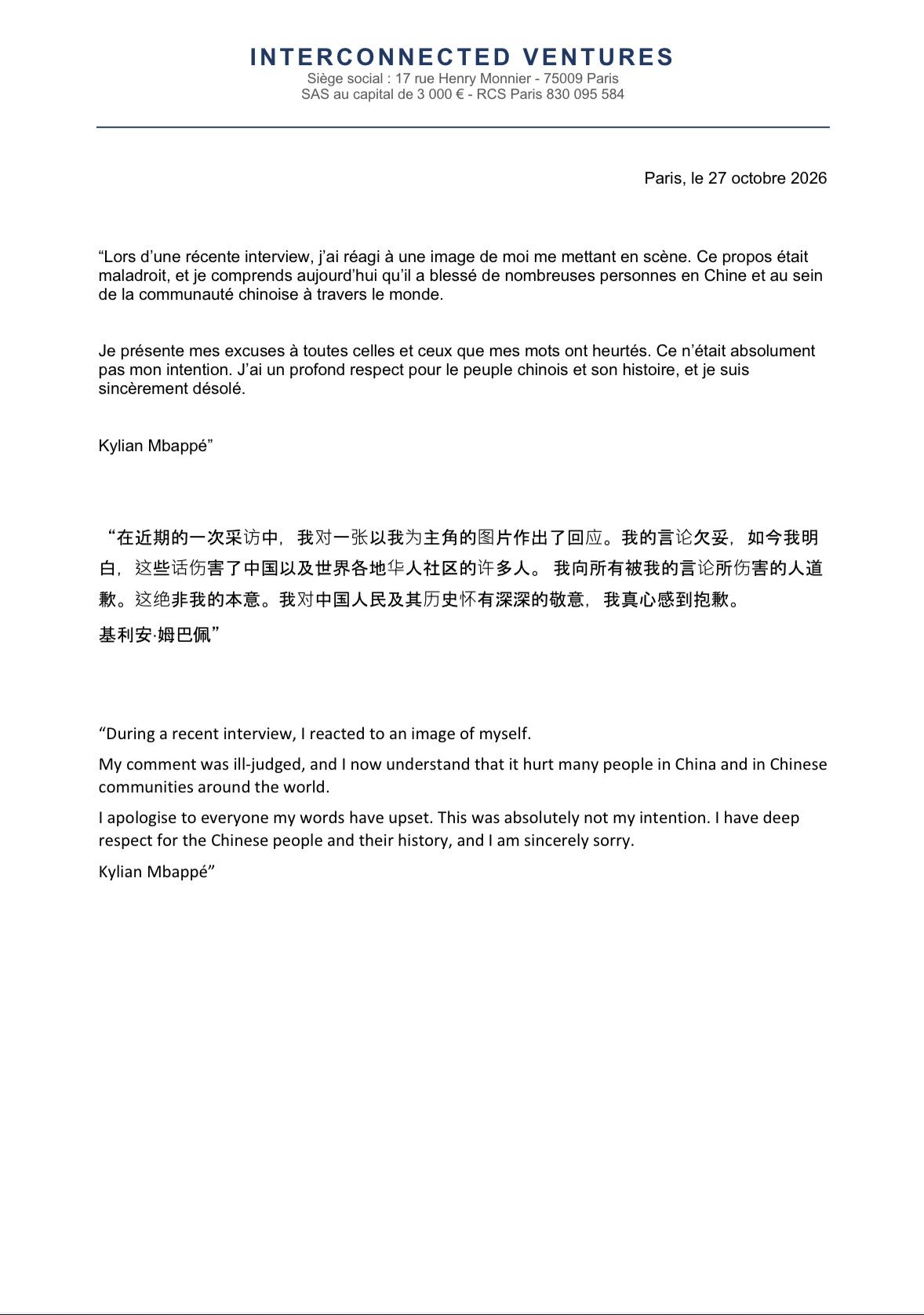 ler Kylian Mbappé and Chinese sensitivities surrounding Mao Zedong raises a question that extends well beyond football: is the world entering an era in which Western cultural authority can no longer be taken for granted?
A Football Controversy With Geopolitical Consequences
The controversy began when a video circulated online in which Mbappé appeared to describe a figure in a meme depicting him as Mao Zedong, a Chinese dictator. The authenticity of the footage was not independently verified by every outlet reporting the story, but the ensuing backlash was real, and Mbappé issued an apology on 27 October 2026, describing his comment as ill-judged and expressing respect for the Chinese people and their history. At least three Chinese companies, including Dongpeng, Mengniu and Milkground, announced the termination of their partnerships with the footballer, while China's state media response extended to suspending broadcasts of Spanish league matches featuring him, according to reporting by the Associated Press and Channel News Asia. La Liga president Javier Tebas also apologised to Chinese fans and reaffirmed the league's commitment to its commercial relationship with China.
The significance of this episode lies not in whether Mbappé's original remark was justified, insensitive or misunderstood, but in how quickly the dispute moved from an individual's comment to a question of international commercial consequences. A globally recognised footballer, major sponsors and a prominent European football organisation all had reasons to consider the reaction of Chinese audiences and institutions. China did not need to control the footballer directly to influence his behaviour, nor did it need to persuade Western audiences to accept its interpretation of Mao's historical legacy. Its ability to impose or threaten commercial costs was sufficient to create an incentive for accommodation. In this sense, the controversy offers a practical demonstration of how market access can become an instrument of geopolitical influence.
Economic Power Is Becoming Cultural Power
The assumption that Western culture would remain the unquestioned global standard was always dependent on the economic structures supporting its international reach. Western entertainment companies, sporting organisations, fashion houses and technology platforms built global audiences by accessing markets across Asia, Africa and Latin America, while many non-Western societies consumed products and cultural narratives created elsewhere. That arrangement gave Western companies considerable influence, but it also created dependencies that could eventually be used by other powers. China is now able to draw on its enormous consumer market, domestic corporate networks, media institutions and political authority to shape the incentives facing foreign brands and public figures. When a global celebrity's commercial interests depend partly on Chinese sponsorships and audiences, cultural expression becomes entangled with the politics of market access.
The underlying shift is therefore not necessarily that Chinese culture has become universally dominant, but that China has acquired greater power to determine what international actors can comfortably say or do within commercial relationships connected to its market. These are different propositions, and confusing them obscures what is changing in the international system. Western cultural products remain widely consumed, Western institutions continue to exercise substantial influence, and Chinese cultural preferences have not simply displaced those of Europe or North America. What has changed is that international businesses can no longer assume that the cultural and political preferences of Western audiences will be the only ones that matter. The world is becoming more plural in its centres of influence, even when those centres disagree sharply about history, political legitimacy and freedom of expression.
The West Helped Establish the Precedent
There is an uncomfortable contradiction in the Western response to the growing willingness of other states to use economic pressure in political disputes. Western governments have long employed sanctions, market restrictions, export controls and financial measures to influence the conduct of other countries, while Western companies have frequently adjusted their operations to avoid political or regulatory consequences. These instruments are not identical to the commercial penalties imposed in the Mbappé controversy, but they reflect a common principle: economic relationships are rarely insulated from political power. The United States' February 2025 executive order imposing sanctions related to the International Criminal Court, followed by further designations of court officials, illustrated how a Western government could deploy financial and legal pressure against an international institution over actions it opposed. The US Treasury's official sanctions record documents the framework, while the ICC has publicly condemned the measures as an attack on judicial independence.
This does not mean that every Western sanction is equivalent to a corporate decision to terminate a celebrity endorsement, or that governments should be prevented from responding to genuine security threats. The legal basis, intended objective and consequences of each measure must be examined on their own merits. Nevertheless, the wider lesson is difficult to dismiss: when powerful states demonstrate that economic pressure is an acceptable means of advancing political interests, they should not be surprised when other powerful states develop and deploy their own methods. The language of sovereignty, national security and public sentiment can serve legitimate purposes, but it can also be used to discourage criticism and narrow the space for independent expression. The resulting international environment is one in which competing powers increasingly seek to define the boundaries of acceptable speech according to their own interests.
China Has Been Here Before
The Mbappé controversy is not China's first confrontation with a major international sports organisation over political expression. In 2019, Houston Rockets general manager Daryl Morey expressed support for protesters in Hong Kong, triggering a severe backlash in China, the suspension of NBA broadcasts and the withdrawal of commercial partnerships. The NBA faced pressure from a market that had become important to its international business, while its leadership struggled to balance commercial interests with the principle that employees should be able to express political opinions. As Reuters reported at the time, the dispute produced immediate economic consequences and forced the league to manage a conflict that extended well beyond basketball.
The recurrence of such disputes suggests that international commercial exposure has become a durable instrument of Chinese influence rather than an isolated response to one celebrity's comment. Companies and public figures operating across borders increasingly have to account for the political sensitivities of audiences in different jurisdictions, especially when those audiences are connected to large consumer markets. The same commercial logic can encourage organisations to defend freedom of expression in one setting while issuing conciliatory statements in another. It is this tension between stated principles and economic incentives that makes the Mbappé case geopolitically revealing. The question is not whether China invented commercial pressure as a political tool, but whether its growing economic position allows it to deploy that tool with consequences that international organisations can no longer easily ignore.
Has the West Lost Its Cultural Dominance?
The claim that Western cultural dominance has ended would be premature. Western films, music, social media platforms, universities, financial institutions and sporting organisations continue to shape international tastes and aspirations, while the English language remains central to much global commerce and scientific communication. Western countries also retain substantial advantages in finance, technology, military alliances and institutional networks. China's growing influence has not erased those advantages, and a single controversy involving a footballer cannot establish that the global balance of cultural power has decisively changed. It would be equally mistaken, however, to assume that Western dominance remains untouched simply because Western cultural products are still popular.
Cultural influence and the power to impose consequences are related but distinct forms of power. A country may enjoy enormous cultural popularity without being able to dictate how international companies behave, while another may command a commercially indispensable market without persuading foreign audiences to admire its political system. China can use its economic weight to encourage compliance with its sensitivities, but that does not automatically make Mao Zedong's legacy more universally accepted or Chinese political values more attractive abroad. Indeed, the use of coercive pressure may generate resentment among some foreign audiences even when companies comply. The more precise conclusion is that Western cultural dominance is facing greater competition from states that possess the resources to make their own political preferences consequential beyond their borders.
The Limits of Economic Leverage
China's leverage is substantial, but it is not without costs. If international celebrities, leagues and companies conclude that ordinary remarks can trigger unpredictable commercial retaliation, some may reconsider the risks of entering or expanding partnerships in the Chinese market. Others will continue pursuing those opportunities because the potential revenue is too significant to ignore, as demonstrated by the NBA's continuing efforts to rebuild its relationship with China after the 2019 dispute. Which effect dominates will depend on the value of the market, the predictability of its regulatory and political environment, the availability of alternative commercial partners and the reputation risks associated with compliance. Economic power can secure immediate concessions, but it cannot guarantee lasting loyalty or cultural admiration.
The same limitation applies to Western governments that rely on sanctions and financial restrictions to influence other states. Such measures can impose serious costs, but they may also encourage affected countries to diversify trade, build alternative financial arrangements and reduce dependence on Western institutions. Neither side can assume that economic pressure will always produce the intended political result. The deeper transformation is that more countries now possess the capacity to impose meaningful costs on international actors, while businesses and individuals must navigate overlapping systems of political expectations. This makes global influence more contested and the consequences of taking a public position more difficult to predict.
The Multipolar World Is Already Taking Shape
A multipolar world does not require the disappearance of Western influence or the emergence of a single replacement hegemon. It describes an international system in which power is distributed among several significant centres, each capable of shaping outcomes in particular domains. The United States and its allies retain substantial advantages in security, finance and technology, while China has become an indispensable economic actor with considerable capacity to influence global manufacturing, trade and commercial access. Other powers and regional blocs also possess leverage in specific markets, resources and diplomatic settings. The result is not an orderly transfer of leadership from Washington to Beijing, but a more competitive system in which different forms of power overlap and sometimes contradict one another.
The Mbappé controversy is a small episode within that larger transformation, yet it provides a useful illustration because the mechanisms are visible. A remark made in a media interview became a commercial dispute, the commercial dispute acquired political significance, and the resulting pressure prompted an international football organisation and a global celebrity to respond. The episode demonstrates that Western fame does not guarantee immunity from the political preferences of other markets, just as Western governments cannot expect their own economic instruments to remain exclusive tools of influence. It also exposes the limits of treating cultural dominance as a permanent condition rather than an outcome sustained by economic and institutional power. The emerging order will be shaped not only by who produces the most popular cultural products, but also by who controls access to markets, platforms, capital and audiences.
Conclusion: A New Era of Contested Influence
The most important lesson from the Mbappé affair is not that China has replaced the West as the dominant global culture, but that the conditions supporting Western dominance are changing. Economic interdependence has created new opportunities for rising powers to convert commercial importance into political influence, while the willingness of Western governments to use sanctions and other forms of pressure has weakened any claim that such instruments belong exclusively to one geopolitical camp. The distinction between cultural popularity and the power to enforce political preferences remains essential, because the ability to compel an apology is not the same as the ability to command global admiration. Nevertheless, the episode reveals that international celebrities, companies and institutions increasingly operate within a world where Western expectations are only one set of constraints among several.
A multipolar world will not necessarily be more tolerant, more democratic or more peaceful simply because power is distributed more widely. It may instead produce competing demands for deference, with different governments seeking to protect their histories, political systems and national narratives from external criticism. The challenge for international institutions and businesses will be to navigate these competing pressures without abandoning consistent principles of expression, accountability and fair treatment. If the Mbappé controversy signifies a new era, it is an era in which no single centre of power can assume that its preferences will automatically prevail everywhere. The decisive question is whether the emerging distribution of power will create greater room for independent societies and institutions, or merely give more governments the means to demand compliance.