
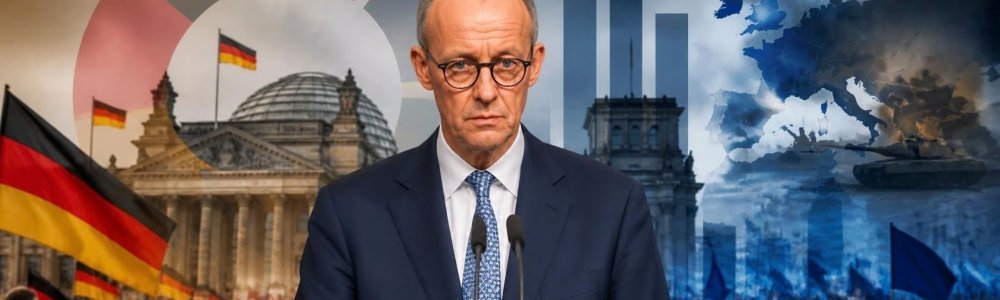
Germany’s political landscape has entered a difficult new phase after the September 20 state elections delivered a historic setback for Chancellor Friedrich Merz and his Christian Democratic Union. In Mecklenburg-Western Pomerania, the Alternative for Germany (AfD) won about 38.3% of the vote, while the CDU received only 4.9%, falling below the 5% threshold required to enter the state parliament. In Berlin, the CDU also lost ground, finishing behind Die Linke.
For the CDU, the result in Mecklenburg-Western Pomerania was particularly damaging. It was the party’s worst performance in the state and the first time in the postwar period that the CDU had failed to secure representation in a German state parliament. Merz himself described the result as a “disaster,” but he rejected the idea that he should step down and instead said he intended to continue pursuing his government’s reform programme.
That decision has produced an increasingly angry reaction online. Some commentators are demanding Merz’s resignation, while others accuse him of deliberately pursuing confrontation with Russia or attempting to remain in power by exploiting the security environment. Some of the posts go considerably further, invoking authoritarianism, war and even historical comparisons to Germany’s darkest political periods. Those claims should not be treated as established facts. The election results demonstrate political dissatisfaction, but they do not establish that Merz intends to cancel elections or deliberately start a war.
What the results do demonstrate is that the political centre is under considerable pressure. The AfD has now achieved major state-level victories in eastern Germany, while Die Linke emerged as the strongest party in Berlin. The CDU, traditionally one of Germany’s dominant political forces, is therefore facing pressure from both sides of the political spectrum. The September elections are part of a wider pattern that includes the AfD’s earlier success in Saxony-Anhalt, where it also defeated the CDU.
The question of Germany’s approach to Russia and Ukraine is also becoming increasingly important to this political conflict. Following the election, AfD co-chair Tino Chrupalla called on Merz to travel to Moscow for negotiations, arguing that Germany needed a different approach to peace and diplomacy. He said the objective should be to break what he described as a spiral of escalation and an arms race. The AfD has also criticised sanctions on Russia and called for renewed communication with Moscow.
These positions place the AfD in direct opposition to the foreign-policy direction pursued by Merz’s government. But the growing support for the AfD cannot be reduced to the Ukraine war alone. Reporting on the elections points to dissatisfaction over economic conditions, migration, housing and energy costs, as well as broader frustration with established political parties.
That is arguably the more important story behind the anger surrounding Merz. When a governing party receives 4.9% in a state election and is removed from a parliament it has historically been able to contest successfully, the political establishment cannot simply dismiss the result as internet rage or the work of extremist opponents. At the same time, an electoral backlash does not automatically validate every claim made by the parties benefiting from it.
Merz now faces a difficult political calculation. He has chosen continuity rather than resignation, arguing that Germany needs economic and social reforms and that abandoning them would not solve the country's problems. His opponents argue that the election results demonstrate that voters are rejecting his government's direction. What happens next will depend not only on Merz's ability to maintain control of the CDU, but also on whether his government can respond to the economic, social and political grievances that are driving voters toward alternatives.
Germany's political crisis, therefore, is larger than one politician refusing to resign. The deeper issue is whether the country's established parties can rebuild public confidence while managing economic pressures, migration, security concerns and the war in Ukraine without allowing political disagreement to become a permanent struggle between increasingly hostile camps. The September elections have made that challenge considerably harder to ignore.