
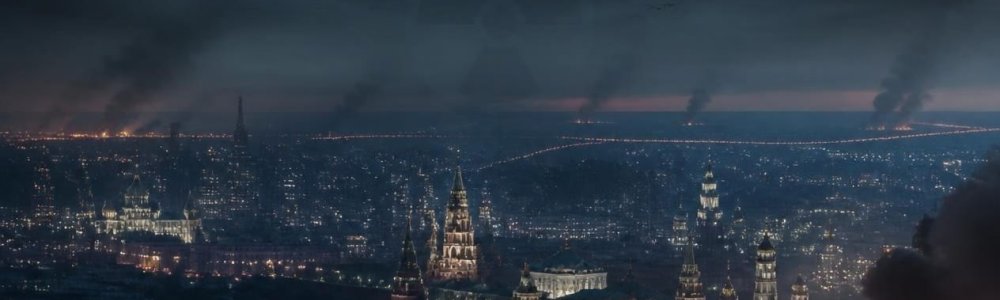
The war in Ukraine has entered another dangerous phase, one in which the distance between the battlefield and the capitals of Europe is becoming increasingly difficult to measure. On September 20, Ukraine launched what Russian authorities described as the largest drone attack on Moscow since the beginning of the full-scale war, with more than 1,600 drones reportedly intercepted across Russia and approximately 450 directed toward Moscow. The attack damaged the Moscow Oil Refinery and residential infrastructure, killed at least two people according to initial reports, and occurred on the final day of Russia's parliamentary elections.
The scale of the attack immediately triggered a much larger argument than the damage itself. Who was responsible for making such an operation possible? How far has Western assistance to Ukraine moved from supplying weapons and intelligence toward direct involvement in the war? And, perhaps most importantly, how much escalation can the European security system absorb before the risks become impossible to control?
These questions sit at the centre of a controversial post by Norwegian political scientist Glenn Diesen. Reacting to the attack, Diesen argued that attacks of such scale, particularly those designed to penetrate Russian air defences, could not realistically occur without NATO participation. He presented the operation as evidence of a political class that, in his view, is taking increasingly serious risks with a confrontation involving a nuclear-armed Russia.
That claim should be distinguished from what has actually been established publicly. Ukraine has developed an increasingly sophisticated long-range strike capability of its own, and Ukrainian President Volodymyr Zelenskyy said the operation used domestically produced drones and targeted Russian oil and logistics infrastructure that supports the war effort. Public reporting has not established that NATO directly participated in launching the Moscow attack.
Yet the question Diesen raises is still significant even without accepting his conclusion.
The attack changes the psychological geography of the war
For much of the conflict, the Russian-Ukrainian war has been understood through images of destroyed cities, trenches and missile strikes concentrated in Ukraine. Long-range Ukrainian drone warfare has gradually altered that picture.
Moscow, which is hundreds of kilometres from the Ukrainian border, is no longer psychologically insulated from the consequences of the conflict. The September 20 operation demonstrated that Ukrainian forces can mount a very large attack against targets in and around the Russian capital, even though Russian authorities said most of the incoming drones were intercepted. The Moscow Oil Refinery, one of Russia's major refining facilities, was damaged in the attack.
This is strategically important because Ukraine's long-range campaign is not simply about causing physical damage. Energy infrastructure is deeply connected to the ability of a state to finance and sustain a prolonged war. Ukrainian officials have repeatedly presented strikes on Russian oil facilities as an attempt to reduce the revenues and industrial capacity supporting Russia's military effort. Zelenskyy described the Moscow strikes in those terms as well.
From Kyiv's perspective, striking deeper inside Russia can therefore be understood as an attempt to impose costs on an adversary that has itself conducted sustained attacks against Ukrainian cities and infrastructure.
But strategic logic does not eliminate escalation risk.
The NATO question is more complicated than a social media argument
Western countries have provided Ukraine with weapons, intelligence, training and other forms of military assistance. That is a documented reality. The much more consequential question is whether such assistance amounts to direct NATO participation in individual Ukrainian operations.
Those are not automatically the same thing.
A Ukrainian operation using Ukrainian-produced drones does not, by itself, establish that NATO forces planned or executed the operation. Likewise, the fact that European states finance or supply military capabilities to Ukraine does not by itself prove that those governments ordered a particular strike.
This distinction matters because the allegation of direct NATO participation carries enormous strategic implications. If Russia interpreted a particular operation as a direct attack by NATO rather than an attack conducted by Ukraine with Western assistance, the potential consequences could be substantially different.
That is where the debate over escalation becomes more serious than the increasingly hostile language appearing beneath social media posts.
The nuclear shadow
Russia and NATO remain the two most consequential military blocs in Europe, and Russia possesses the world's largest nuclear arsenal alongside the United States. The possibility of a direct Russia-NATO confrontation has therefore been one of the most important constraints on Western policy throughout the war.
The concern is not that every Ukrainian strike against Russia automatically brings the world closer to nuclear war. That would be an exaggeration. Russia has endured years of attacks on military and energy targets without initiating a direct conventional war against NATO.
The danger lies instead in miscalculation.
A conflict can escalate not only because leaders deliberately choose a larger war, but because one side misreads the intentions, capabilities or limits of another. An attack intended to damage an oil facility could be interpreted politically as an attack on the state itself. A military assistance programme intended to strengthen Ukraine could be interpreted by Moscow as evidence of direct Western participation. A retaliatory strike intended to remain below a particular threshold could nevertheless kill foreign personnel or strike a politically sensitive target.
Once several such steps accumulate, the original intentions of the participants may become less important than the new reality created by their actions.
The election timing adds another layer
The Moscow attack also occurred during the final day of Russia's parliamentary elections. Russian authorities accused Ukraine of attempting to disrupt the vote, while Ukrainian officials presented the strikes primarily as attacks against infrastructure supporting Russia's war effort.
The timing therefore gave the attack a political dimension beyond its military objectives.
The elections themselves were taking place under highly restricted political conditions. The Associated Press reported that the Kremlin's ruling United Russia party maintained its dominant position and that opposition participation was heavily constrained.
That context makes it difficult to reduce the attack simply to an attempt to "stop an election." There is no public evidence establishing that Ukrainian forces could have expected the drone campaign to overturn the electoral process. The more concrete strategic explanation is that Ukraine was attempting to strike Russian infrastructure and demonstrate that even the capital region could not be completely shielded from the war.
The reactions reveal something deeper
The responses to Diesen's post demonstrate how deeply divided the information environment surrounding the war has become.
Some commenters argued that attacking Moscow risks provoking devastating Russian retaliation and potentially expanding the conflict. Others described the operation as a legitimate consequence of Russia's invasion and argued that Ukraine has the right to strike infrastructure sustaining Russia's military campaign.
Some went further, making claims that Russia was about to attack London or Brussels, that NATO was effectively conducting the war through Ukraine, or that the Ukrainian state was simply a Western proxy. Others portrayed Russia as exercising extraordinary restraint.
These claims should not simply be treated as established facts. They reflect competing narratives about the war, often expressed in deliberately provocative language.
The underlying disagreement, however, is real.
One side sees long-range Ukrainian strikes as part of Ukraine's effort to defend itself and impose costs on the state that invaded it. Another sees the increasing depth and sophistication of those strikes, combined with Western military assistance, as evidence that the conflict is moving toward a confrontation between Russia and the broader Western security system.
Both interpretations cannot be treated as identical descriptions of reality, but the existence of the second concern cannot simply be dismissed either.
The real danger is the disappearance of limits
Wars become particularly dangerous when the boundaries separating direct and indirect participation become increasingly unclear.
Ukraine is fighting for its survival and has strong incentives to develop weapons capable of striking Russian military and economic targets at greater distances. Western governments have strong incentives to help Ukraine without becoming direct belligerents against Russia. Russia has strong incentives to retaliate against Ukrainian military capabilities while attempting to avoid a direct confrontation with NATO.
Those incentives can coexist for a long time. But they also create opportunities for miscalculation.
The September 20 attack illustrates that problem vividly. Ukraine demonstrated an expanding ability to reach deep into Russia. Russia demonstrated that its air-defence network could intercept large numbers of incoming drones but could not prevent all of them from reaching their targets. Western governments now face the continuing challenge of supporting Ukraine while managing the risk that military assistance will be interpreted as direct participation in the conflict.
The question is therefore not simply whether Ukraine has the right to strike Russia or whether Russia has the right to retaliate. The more consequential question is where the participants believe the limits are, and whether those limits are understood in the same way by everyone involved.
In a war involving a nuclear power and a military alliance dominated by other nuclear powers, that distinction is not academic.
The danger of escalation does not require anyone to desire a world war. It can emerge from a sequence of decisions in which every individual step appears manageable until the accumulated consequences become much harder to control.
That is the warning embedded, however controversially, in the debate surrounding the Moscow attack. The further this war extends its reach, the more important it becomes for governments to communicate clearly what they are doing, what they are not doing, and where they believe the boundaries of the conflict actually lie.
Because once those boundaries become ambiguous, the greatest danger may no longer be the weapons that either side deliberately launches. It may be the assumptions each side makes about what the other side will tolerate.